
Helping Veterans access care and benefits online
Description
We joined the modernization effort at VA to implement a modern Drupal content management system and empower a Veteran-first approach to online healthcare.
Teaser Image
Image
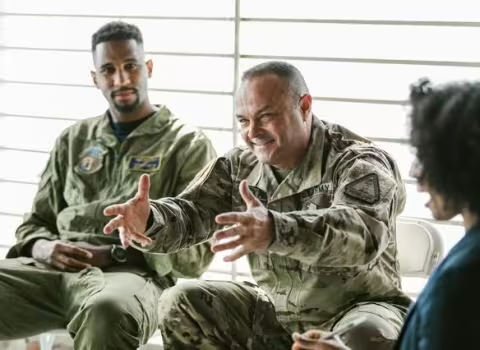
Two soldiers in camouflage speak with a woman during a counseling session.
Body

The challenge

The U.S. Department of Veterans Affairs (VA) is working to improve the confusing experience many Veterans have when navigating multiple VA sites built on a mix of legacy technologies.

Having launched a reinvigorated VA.gov in 2018 as an important step to a unified Veteran-first digital platform, the agency still needed to build out a common content management system (CMS), establish consistent descriptions for services, and organize the information in an accessible way for Veterans in need of health care.

Client goal

The large-scale pilot effort focused on using one of the regional VA Medical Centers as a model for all future VA.gov content. This would empower the VA to:

  • Provide better healthcare management and scheduling online
  • Explain benefits clearly and provide intuitive paths to apply for them
  • Help minority and women Veterans find services specific to their needs
  • Provide online connection with care coordinators
  • Establish a model for content publishing and governance VA-wide

We integrated the new CMS with the existing site architecture and helped create standards for content and design that make it easier for VA staff to do their jobs—while directly improving quality of life for millions of Veterans seeking health care and benefits.

Our approach

Working alongside our partners Agile Six and Nava in collaboration with the U.S. Digital Service at VA and other organizations, our team was one of many moving parts in a complex project. We provided technical leadership and modeled transparent communication practices that helped the various teams work effectively together.

The technical strategy shifted to a “decoupled” approach partway through the project, requiring us to integrate the new CMS backend with the VA’s existing frontend system so that Veterans and caregivers could access content across multiple platforms. Agile practices helped us navigate this and other evolving priorities in a large ecosystem undergoing significant changes.

Smooth the technical transition

We managed the move to the new CMS without “pausing” the old site so the VA could re-use their existing front-end technology instead of starting from scratch. This meant we had to juggle content being served from two sources (GitHub and Drupal) during the transition, while training VA staff to use the new CMS effectively. We also set up a CI/CD pipeline for automated testing to ensure healthy functioning systems.

Find out what people need

To make sure health services and benefits are easy to find and understand, we tested navigation and content with real people, including unique groups like women, minority, and LGBTQ Veterans. We also interviewed VA staff responsible for maintaining the website, to understand their pain points and develop authoring and approval processes that make their jobs easier.

Empower a Veteran-first approach

The VA has been working to pave the way for a Veteran-focused digital experience, and this project was a landmark moment in propagating that approach throughout the organization. Human centered design and plain language are no longer the sole purview of digital experts — we developed systems that allow VA staff across the country to participate in the modernization of service delivery.

Outcomes

Improved customer experience

Veterans and caregivers can navigate the new VA medical center websites with ease. With 1 - 2 clicks, they can apply for benefits, schedule appointments, refill prescriptions, or learn more about VA services.


Secure data

The VA handles a lot of personally identifiable information, so we used an “API-first” approach that encapsulates data access behind an API that requires authentication.


Plain language

Service descriptions across VA websites were previously inconsistent and confusing. We helped analyze and restructure legacy content into user-friendly language, which was then applied across VA medical centers nationwide.


Informed product strategy

We worked with product designers responsible for the long-term digital modernization at VA, so they can better understand how to involve Drupal (their chosen CMS) in their product strategy.


Empowered content editors

Staff responsible for updating VA online content can do their jobs better with the new CMS. Smart governance processes powered by Drupal help content authors maintain consistency across VA-wide benefits information.


Increased usage of benefits

This work, as part of the large-scale modernization of VA.gov, has resulted in more Veterans interacting with VA services online. This means Veterans have more control and easier access to critical benefits and healthcare.


Proof points
Value
2,019
Description

health services audited and consolidated

Value
38
Description

research sessions with VA content authors

Value
1 - 2
Description

clicks on any device for Veterans to find what they need

Improving the online experience for Medicare beneficiaries with WECMS

Description
We are working to re-platform and redesign legacy systems for CMS, making it easier for millions of people to get the benefits they need.
Teaser Image
Image
Photo of a smiling girl holding flowers beside her grandfather outdoors.
Body

The challenge

The Centers for Medicare and Medicaid Services (CMS) provide healthcare benefits to millions of people every year. But the websites and digital tools that help people find and enroll in these programs were built on a myriad of aging technologies and were confusing to navigate. CMS needed to streamline and update its online platforms to improve the customer experience while establishing more efficient backend workflows for agency staff.

This is an enormous and complex task, involving the modernization of Medicare.gov, CMS.gov, CMS open data portals, and many other public facing apps that serve multiple user groups — including beneficiaries, caregivers, health providers, data professionals, and government stakeholders.

WECMS helps more than 100 million Americans every year apply, find, and enroll in healthcare programs. The information and tools provided are essential components in supporting CMS' goals of creating a truly consumer-focused, streamlined, efficient, and omni-channel experience for beneficiaries and their caregivers. The overall intent for this contract is to ensure continuity of operations for the Americans it serves and the WECMS program, which maintains, designs and implements open source software digital services for CMS’ flagship websites, tools, components and applications on Healthcare.gov, Medicare.gov, CMS.gov, and 7 Open Data catalogs. In addition to engineering and design continuous improvements on these established websites, this contract provides security compliance, devops, system infrastructure, content strategy, information architecture, training, documentation, content editor support, public call center dev support, Section 508 improvements, mobile application development, and tooling and systems expertise.

Client goal

When this multi-year transformation is complete, CMS will be able to deliver on its mission more effectively. CivicActions is providing agile development, DevOps, and human-centered design (HCD) services to help the agency:

  • Improve the content editing experience for staff
  • Modernize legacy systems and tools
  • Replace proprietary technologies with open source
  • Support active, informed healthcare consumption

Our approach

Collaboration is the key to success in a project of this scale and complexity. With multiple partner vendors (including our primary partner Fearless) and disparate stakeholders across many organizational layers, we work hard to keep lines of communication open and be up-front about potential problems.

Balancing stakeholder priorities, user needs, technical complexity, and CMS deadlines, we created a roadmap that minimizes risk and maximizes opportunities for success. Then we went to work on “quick wins” — tasks we could complete right away that would make the biggest difference for users.

Address the holistic customer experience

We knew that each CMS application is part of a huge public-facing ecosystem of digital tools, with many touchpoints. To address the entire experience that a person would have in navigating the systems, we drew on the agency’s own knowledge of their beneficiary community, working with them to refine and document how each person interacts with CMS online. The resulting holistic view helped us identify how we could improve that experience iteratively.

Adopt a data-driven strategy

To make sure we built the right solutions, we immersed ourselves in the CMS mission from the operational, technical, and UX perspectives. We dug into existing user research, reviewed analytics reports, conducted stakeholder interviews — then created user personas and journey maps to refine the project scope and goals. All this data is managed in a shared repository of user insights and project knowledge, which we refer to as we prioritize the work to be done.

Replace proprietary software with open source

We are “reverse engineering” multiple custom-built Microsoft.NET applications (such as the Medicare Eligibility and Premium Calculator and the congressionally-funded Physician Fee Schedule (PFS) Lookup Tool with modern, open source solutions. As we recreate all these applications in Drupal, we’re making guides and code documentation that outline the entire system — allowing CMS to maintain control of its own technologies and avoid vendor lock-in. We are also migrating CMS open data platforms from Socrata (proprietary) to an open source solution using DKAN 2.

Outcomes

Clean and useful technology

CMS struggled to make use of technologies built on old, messy code that had been around for years. We are not only modernizing the CMS tech stack, we are documenting how it works and how to use it.


Accessible services for all

508 compliance is required, but we consider accessibility as more than a checkbox. Because CMS serves a population with a proportionately higher level of impairments, we put extra emphasis on accessibility best practices.


Agile delivery at scale

We are managing this project using the Scaled Agile Framework (SAFe), working iteratively with broad cross-team collaboration and stakeholder input across the organization. Value is delivered with releases every two weeks.


Intuitive digital tools

Beyond CMS websites, we are modernizing cost calculators, finders, mobile apps, interactive map models, open data site applications, and lookup tools that are used by providers and beneficiaries to perform critical healthcare tasks.


Well-informed solution

We apply human-centered design to understand the goals of end users and CMS stakeholders, while layering in a thorough understanding of the policies that underpin each program — so the end results meet real needs.


Ongoing technical support

To improve and maintain the CMS systems, we provide 24x7 operations and maintenance support, editor feature enhancements, guidance content and APIs per executive orders, and new content sections as needed.


Proof points
Value
100 M
Description

Americans depend on CMS for health benefits

Value
10
Description

legacy applications migrated and rebuilt in Drupal

Value
24x7
Description

O&M support provided to critical healthcare systems